App Helps Neighbors Invest in Local Clean Energy
A school in Madrid is now powered by solar panels on its roof thanks to investments from local residents. People could put in as little as €20, yet together they raised almost €150,000.
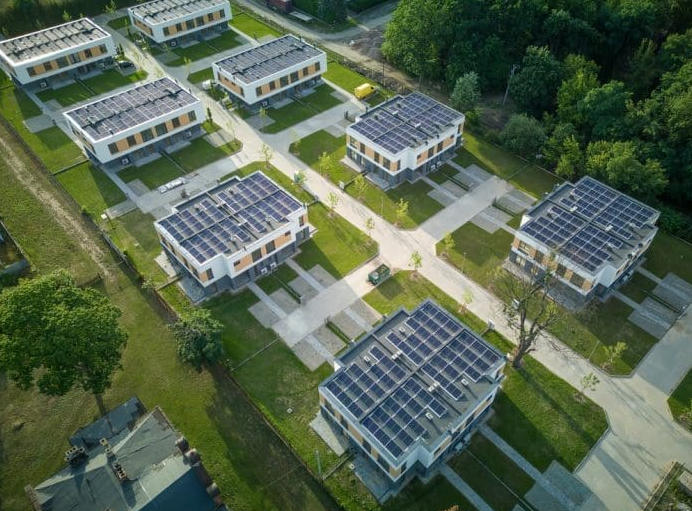
The crowdfunding campaign for the Palomeras school was part of AURORA, an EU-funded initiative that uses a simple smartphone app to help citizens track their energy use and invest in local clean energy projects.
Since the collaboration began in December 2021, several thousand people in Denmark, Portugal, Slovenia, Spain and the UK have downloaded the AURORA Energy Tracker app. It offers practical ways to reduce personal carbon footprints, such as joining community schemes to install solar panels.
“We are giving power to the people,” said Ana Cristobal, a professor at the Universidad Politécnica de Madrid, Spain, who led the project.
Turning everyday choices into climate action
As part of its European Green Deal, the EU has set targets to reduce greenhouse gas emissions by at least 55% by 2030, compared to 1990 levels, with a proposed 90% cut by 2040 and climate neutrality by 2050.
Various studies, including those by UN climate experts, suggest that individual actions, supported by policy and technology, could reduce global emissions by 40 to 70% by 2050. Yet progress has been uneven, and there has been pushback against what some see as constant lecturing.
“Some people feel politicians are always telling them how to behave, and that can turn them against taking action,” Cristobal said. There is also a practical problem. Many people simply do not have the flexibility to follow well-intentioned advice.
Cristobal herself drives 10 minutes to work. Taking public transport would take more than an hour.
“I have three kids, and my life is very complicated. I cannot afford to spend that long on public transport,” she explained. “But I might compensate for this behaviour by doing something else positive.”
The app is designed to help people do just that. Users enter information about their electricity, heating, and transport habits and receive an energy label, along with tailored suggestions for cutting emissions adapted to their country.
Ambassadors for citizen energy
“This is a way to support ordinary people in reducing their carbon footprint,” said Martin Brocklehurst, a consultant and chair of the Citizen Science Global Partnership, a Vienna-based network linking citizen science organisations with UN agencies.
Brocklehurst was one of AURORA’s Citizen Science Ambassadors, helping to promote the app, explain how it works and encourage students, residents and municipalities across the EU and the UK to join community energy schemes. The idea is to turn a technical project into a citizen movement.
Unlike many similar apps, Brocklehurst said, AURORA provides an accurate picture of personal carbon footprints. He tested it himself. After tracking his emissions for two years, he reached net zero for his home energy use and travel – excluding international flights.
“It made me ask questions like: do I really need to fly so much? Could more meetings be online?” he said. “And there are also ways to cut emissions that can actually earn people money.”
Solar power, local money
At the Palomeras school, photovoltaic panels now generate electricity on-site, while heat pumps have replaced a less-efficient cooling system. This matters in Madrid, where climate change is bringing more frequent and intense heatwaves.
More than 170 people from the surrounding Vallecas neighbourhood – a historically working-class area in southeast Madrid – invested in the project. After four months of crowdfunding, almost €150,000 had been raised working with a local solar energy cooperative.
Brocklehurst recalled Sarah Alcantarilla Moreno, head of studies at Palomeras school, telling an online energy event: “We never thought we could get that amount of money from a working-class area of Madrid.”
For investors, the app calculates how much fossil fuel use and carbon emissions their contribution helps to offset. They also receive a rate of return on their investment that is often higher than standard bank savings. Once the investment is repaid, the school is expected to cut its energy bills by around 40%.
“We can show people how to lower their energy costs and get a return on investment that benefits their community,” Brocklehurst said. It can reduce energy prices by around 10%, or as much as 40% if a local energy scheme is developed.
“All these schemes divert fossil fuel company profits back into local communities and/or community energy co-operatives,” said Brocklehurst.
What EU funding made possible
EU funding allowed the AURORA team to test this approach in very different settings, from a working-class district in Madrid to university campuses across Europe. Comparing experiences revealed how national rules and social attitudes can either support or block community energy projects.
Similar schemes were explored at universities in Slovenia, Portugal and Madrid, but all ran into legal hurdles. Complex rules on who can own rooftop panels, how electricity can be shared and how citizen crowdfunding can operate often slowed progress.
At Aarhus University in Denmark, however, solar panels were installed on engineering buildings, and a community energy scheme now sells power directly to the university.
“When I started my PhD, the technology was too expensive,” Cristobal said. “Now the main barriers are legal.” Removing them, she argues, should be a priority for policymakers.