Indoor Solar Power Harnessing Light from Everyday Spaces
Solar power has long been associated with rooftops, sunlight, and wide-open skies. Yet much of modern life happens indoors, under office lights, kitchen lamps, and the soft glow of our homes. As our world fills with small electronic devices that operate quietly in the background, the question arises: Can solar energy work indoors too?
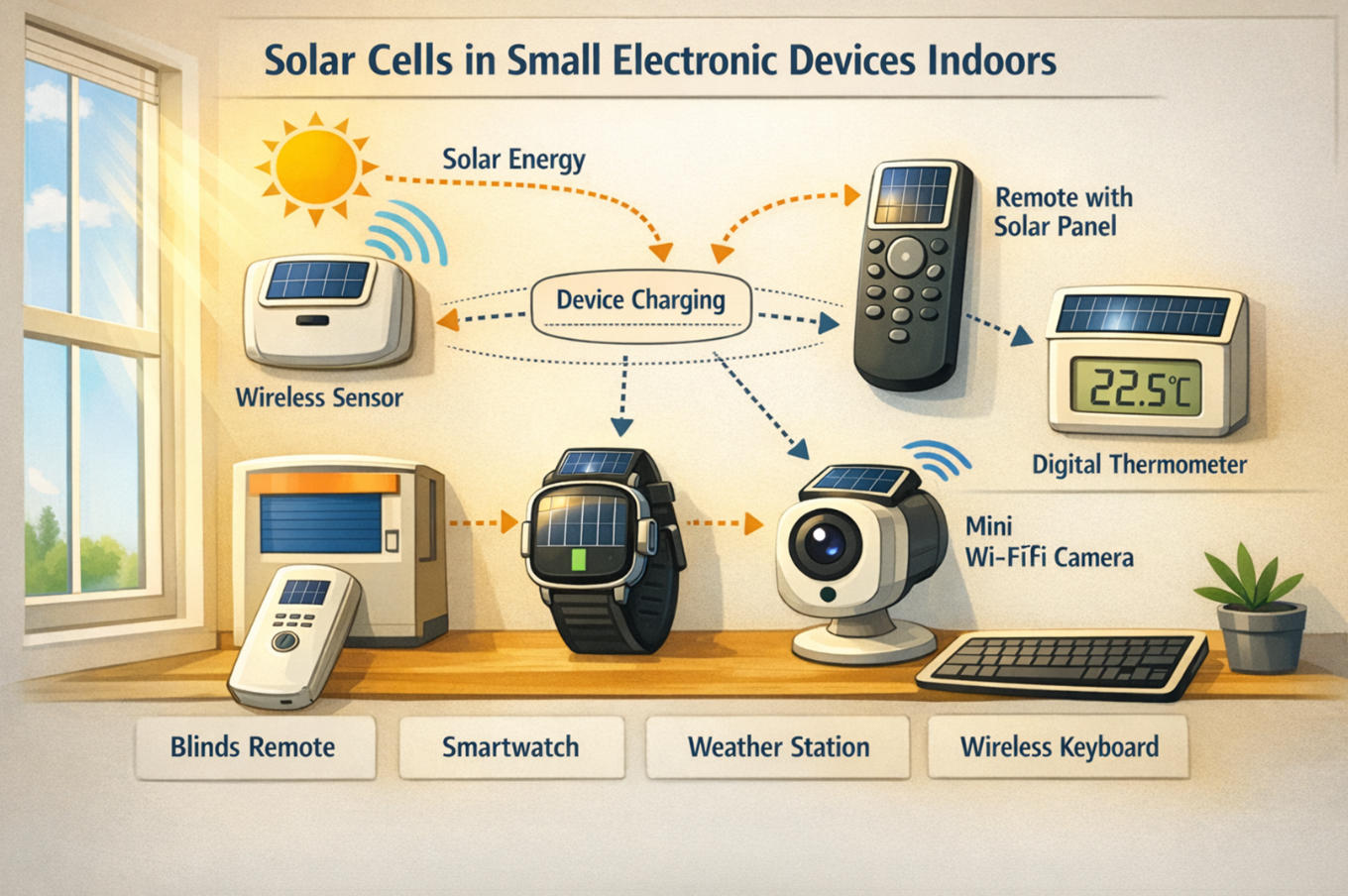
The answer is yes, and it may lie in a relatively simple, Earth-abundant material: antimony sulfide (Sb?S?).
Why Indoor Solar Cells Matter
Modern life is filled with small devices that need constant power: smart sensors that monitor air quality, wearable health devices, electronic labels, and Internet of Things (IoT) systems embedded in homes and workplaces. These devices consume very little energy but rely heavily on batteries.
Replacing and disposing of batteries is inconvenient, costly, and environmentally harmful. Indoor solar cells offer a compelling alternative: devices that power themselves using the light already around them.
Indoor photovoltaics—the conversion of artificial light into electricity—have become one of the most active areas in solar research. Unlike outdoor solar panels, indoor solar cells do not need to generate large amounts of power. Instead, they must work efficiently under low-power lighting.
Sb?S?-based indoor solar cells could help make this vision practical, enabling electronics that operate continuously without battery replacement.
A Rising Star in Indoor Solar Energy
Recent research shows that Sb?S? is particularly well suited to harvest indoor light sources such as LEDs and fluorescent lamps. As scientists search for practical materials for indoor energy harvesting, Sb?S? is emerging as a promising candidate.
What makes Sb?S? compelling is its unique nature: it is environmentally friendly, Earth abundant, and intrinsically stable. It avoids toxic or scarce elements, making it a sustainable alternative for large-scale photovoltaics. With a bandgap of approximately 1.7–1.8 eV and a high absorption coefficient, it is especially well suited for indoor photovoltaic applications. While its current outdoor efficiency remains below that of crystalline silicon, Sb?S? demonstrates remarkable performance under low-intensity illumination and offers excellent stability. These attributes position Sb?S? as a promising candidate for indoor energy harvesting and IoT applications.
A Glimpse Inside the Laboratory
Behind this technology lies careful laboratory work. Research does not begin with finished products but with simple glass substrates and thin layers of material applied step by step. Scientists adjust conditions, refine processing steps, and test how small changes affect performance.
Through controlled heating and precise layering, Sb?S? is transformed from a raw material into a functional component capable of converting indoor light into electricity.
An Early but Powerful Technology
The use of Sb?S? for indoor solar applications is still emerging, and researchers are only beginning to uncover its full potential. Over the past decade, device efficiencies have steadily improved from early architectures to more optimized thin-film structures under standard illumination, with even higher relative performance reported under indoor lighting conditions. Beyond efficiency gains, new features are expanding its appeal. Semi-transparent Sb?S? devices are being explored for smart windows and building-integrated photovoltaics. Promisingly, each experiment adds another piece to the puzzle, steadily opening doors to better designs and broader real-world adoption.
Powering the Future
As buildings become smarter and devices more connected, indoor solar cells could become an unseen but essential part of our environment. And somewhere behind that quiet power source will be a simple material, refined in the lab, now working silently under indoor light.
Part of that future is taking shape today in our laboratory, where we are uncovering new ways to unlock the full potential of this material.